The search for a reliable couch cleaning service tends to happen in one of two situations. The first is when something specific goes wrong — a spill, a pet incident, a smell that’s been building long enough that it can no longer be ignored. The second is when a homeowner decides to treat upholstery cleaning as a scheduled maintenance task rather than a reactive one. The two situations call for the same service, but the way people evaluate and choose a provider differs significantly between them, and the reactive search almost always produces worse outcomes than the planned one.
When you’re searching for couch cleaning near me under pressure — something just happened to the sofa — the tendency is to book whoever can come soonest at a price that seems reasonable, without doing the evaluation that would normally inform a service decision. The result is sometimes excellent and sometimes disappointing, and the difference usually traces back to things that were visible before booking if anyone thought to look for them.

What a Professional Process Actually Looks Like
One of the main reasons couch cleaning results vary so widely is that the category description covers a wide range of actual practices. At the lower end, “professional couch cleaning” means a technician arriving with a portable spray machine, applying a general-purpose upholstery cleaner, extracting it with a wet-vac, and leaving within 45 minutes regardless of what the furniture looked like at the start. At the upper end, it means a fabric assessment before any product is applied, colorfastness testing on a hidden area, stain-specific pre-treatment with chemistry matched to the type of stain, hot water extraction that flushes the foam substrate rather than just the surface fabric, a residue rinse to prevent rapid re-soiling, and accelerated drying with professional air movers.
These two approaches produce meaningfully different results, and they’re frequently priced within the same range. The way to tell them apart before booking is to ask — specifically — what the process includes. A service that can describe their pre-treatment step by stain type, or explain why they test colorfastness first, is operating with a level of technical understanding that produces better outcomes. A service that responds to process questions with vague reassurance is probably not operating at that level.
Equipment Matters More Than Most People Realize
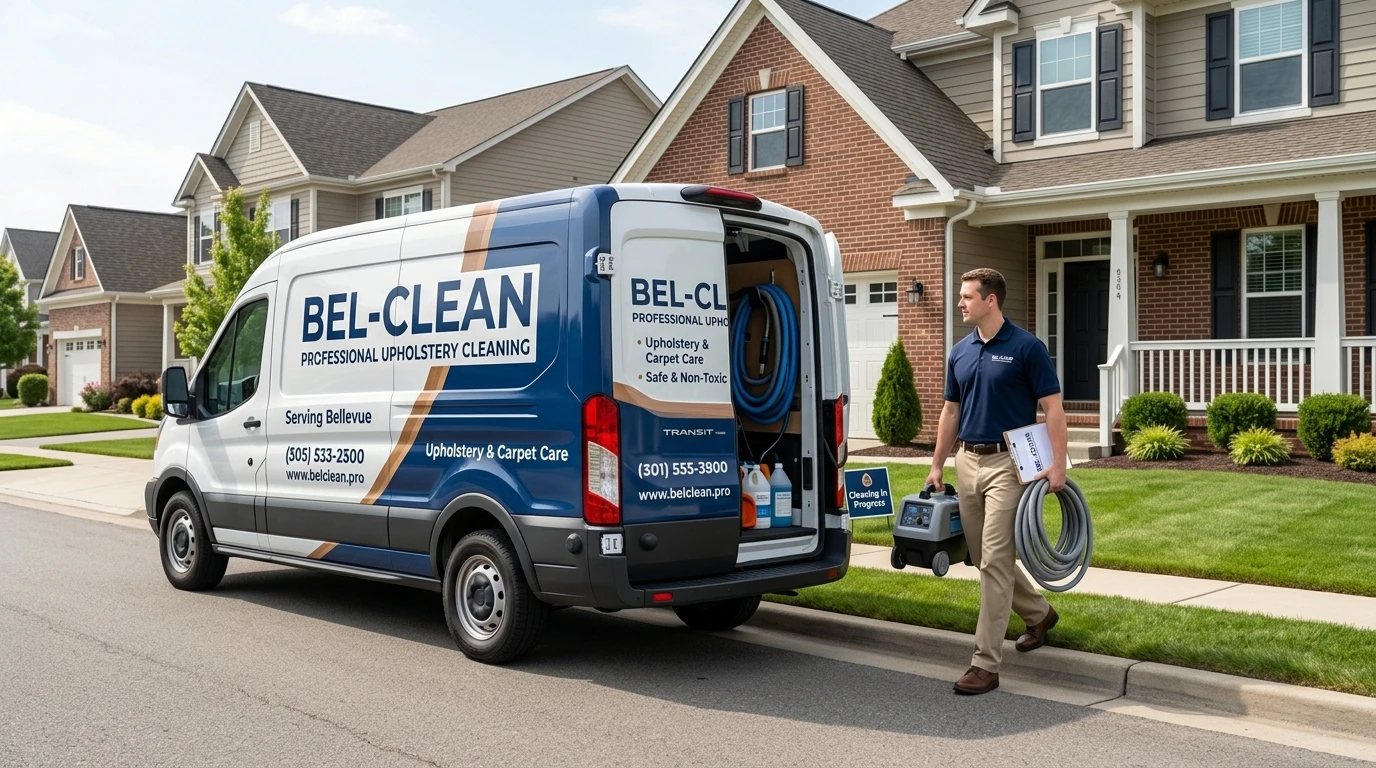
The distinction between truck-mounted extraction systems and portable units is the single largest variable in how well upholstery cleaning works and how quickly furniture dries afterward. Truck-mounted systems — where the main pump and heater stay in the service vehicle and only the hose and wand come inside — generate dramatically more suction and heat than portable machines. More suction means more of the cleaning solution and dissolved soils are actually extracted from the foam substrate. More heat means the hot water extraction temperature is high enough to break down oils and kill dust mite allergens rather than just moving them around.
The drying time difference is significant: truck-mounted extraction with professional air movers typically results in fabric dry to the touch within two to four hours. Portable unit cleaning with inadequate extraction often leaves residual moisture that takes six to twelve hours to fully dry — during which time the fabric is vulnerable to mildew development inside the cushion foam, particularly in humid climates. This is the specific mechanism behind the common complaint where a sofa smells fine immediately after cleaning and progressively worse over the following week.
The Questions Worth Asking Before You Book
Three questions reliably separate the providers worth hiring from those worth skipping. The first: do you do a fabric assessment before cleaning? The correct answer is yes, because different fabric types require different cleaning methods — a water-based extraction that works well on polyester and cotton can permanently mark microfiber coded for solvent-only cleaning, and velvet requires entirely different handling from woven fabric. A service that doesn’t assess before treating is either applying the same method to everything regardless of fabric, or winging it.
The second question: what happens if I’m not satisfied with a result? Look for a specific commitment — a return visit within 48 hours to address any area that didn’t clean to your satisfaction — rather than a generic “we stand behind our work.” Vague satisfaction guarantees are costless to offer and difficult to enforce. Specific commitments describe an actual process.
The third: how long will the furniture take to dry? The honest answer, with proper equipment, is two to four hours with ventilation. Anything significantly shorter suggests inadequate moisture extraction. Anything longer than six hours suggests equipment that isn’t generating sufficient suction to remove the cleaning solution properly.
Scheduling: The Difference Between Reactive and Maintained
The households that consistently get good results from upholstery cleaning are mostly the ones that don’t wait for a visible trigger. Regular scheduling — every 12 to 18 months for typical households, more frequently with pets or children — means each cleaning appointment is a maintenance visit rather than a recovery operation. Maintenance cleaning on fabric that’s been cleaned within the past year produces more complete results, dries faster, and requires less aggressive pre-treatment than cleaning on fabric that hasn’t been professionally treated in three or four years.
Finding an upholstery cleaning near me service you can return to reliably is worth the extra evaluation time upfront. A technician who has cleaned your furniture before knows the fabric type, knows any pre-existing conditions, and can complete the job more efficiently on repeat visits. The relationship with a cleaning service that understands your household’s specific furniture is more valuable than the marginal price difference between providers — and it’s the thing most people don’t factor into the initial search at all.